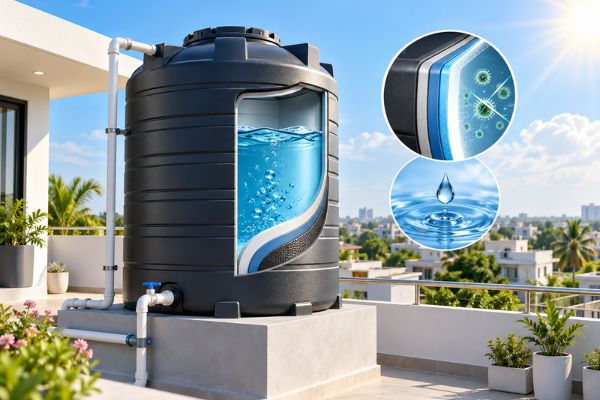
What Should You Check Before Buying an Antibacterial Water Tank
An antibacterial water tank should be selected by checking its product claims, drinking water suitability, capacity, and installation requirements. The antibacterial label alone does not tell you how the tank performs or whether it suits your property.
For homeowners and building managers, buying the wrong tank can create problems beyond storage. An oversized tank may hold water longer than needed, while a poorly planned installation can make cleaning and maintenance difficult.
This guide focuses on the questions to ask before purchasing a rooftop tank. It explains how to review product information, plan storage, and compare quotations without relying only on price or advertised features.
Understand What Antibacterial Protection Covers
An antibacterial water tank is designed to inhibit bacterial growth through a treatment or additive used in its construction. The exact protection depends on the product and its tested performance.
Ask the supplier whether the claim applies to the inner tank surface, stored water, or both. Request supporting documents for the specific model being offered.
Do not assume that an antibacterial claim also proves protection against algae, fungi, or every harmful organism. Each claim needs its own evidence. Clear product information helps buyers understand what they are paying for.
Does an Antibacterial Water Tank Purify Water
An antibacterial water tank should not be treated as a water purifier. Storage features do not automatically remove dissolved salts, chemicals, sediment, or all microorganisms from incoming water.
If the water source needs treatment, choose suitable treatment based on water testing and professional advice. Tank selection and water treatment serve different purposes.
Likewise, clear water is not proof of drinking water safety. Buyers should check the source water quality and confirm that the selected tank is intended for potable water storage.
Choose Capacity Around Actual Water Use
Tank capacity should reflect daily consumption, supply interruptions, and the available installation space. Selecting the largest tank that fits is not always the best decision.
Review these details before requesting a quotation:
- Number of people using the property
- Typical daily water consumption
- Frequency and duration of supply interruptions
- Separate drinking and general water requirements
- Available rooftop space and access
- Expected changes in occupancy
A plumber or building services professional can help calculate suitable storage. Plan enough reserve for your needs while avoiding unnecessary storage that leaves water unused for long periods.
Check Rooftop Access and Structural Support
Before buying a rooftop antibacterial water tank, measure the installation area and the route used to move the tank into position. Check stairways, doors, lifting access, and overhead obstacles.
A filled tank adds substantial weight. The roof and supporting structure should be assessed for the proposed installation, especially when replacing a tank with a larger model.
Follow the manufacturer’s base requirements. Ask your installer to provide proper pipe support so connected plumbing does not place unnecessary strain on the tank outlets.
Compare More Than the Number of Layers
Layer count is one product feature, but it does not explain the complete tank design. Compare the actual specifications and service requirements.
| Selection Point | What to Check Before Buying |
|---|---|
| Antibacterial Claim | Test evidence and scope of protection |
| Drinking Water Use | Documentation for potable water suitability |
| Outdoor Exposure | Manufacturer guidance on UV resistance |
| Capacity and Dimensions | Storage needs and installation space |
| Lid and Openings | Secure closure and maintenance access |
| Plumbing Connections | Outlet sizes and approved connection method |
| Warranty | Coverage, exclusions, and claim procedure |
A clear specification sheet is more useful than broad promises such as “completely safe” or “maintenance free.”
Plan Cleaning Access Before Installation
An antibacterial water tank still needs inspection and cleaning. Dust, sediment, and contamination can enter through the water supply or poorly protected openings.
Choose a location where trained service staff can reach the tank safely. Keep access to the lid available and ask how the tank can be drained for maintenance.
Follow the manufacturer’s cleaning instructions. Set the inspection schedule around local water conditions and building requirements. Antibacterial protection should support a maintenance plan rather than replace it.
Compare the Complete Purchase Cost
When comparing antibacterial water tank prices, request quotations for equivalent capacities and models. Check what each quotation includes.
The total cost may include delivery, rooftop handling, base preparation, plumbing fittings, installation, and removal of an old tank. Confirm these items before approving the purchase.
For enquiries in Ahmedabad or elsewhere in Gujarat, share the delivery address, required capacity, installation position, and access details. Universal Plastic Agency lists Dutron Plus antibacterial water tanks and can be contacted to confirm current specifications, availability, and quotation terms.
Conclusion
Buying an antibacterial water tank involves more than choosing a brand or layer count. Check the evidence behind its antibacterial claim, confirm drinking water suitability, and select a capacity that matches actual use.
Plan rooftop support, installation access, and cleaning arrangements before ordering. These checks help you compare products fairly and avoid unexpected work after delivery.
For product enquiries, contact Universal Plastic Agency with your required capacity and installation details. Ask for the model specifications, warranty conditions, and complete delivered price before making your decision.
Frequently Asked Questions
Request the product specification sheet, relevant antibacterial test information, drinking water suitability documents, and warranty terms. Confirm that the documents apply to the exact model quoted.
Choose capacity based on household consumption and supply interruptions. Share occupancy and water availability with your plumber so the recommendation matches your needs and rooftop conditions.
Compare the documented features with your requirements. Consider product quality, tested claims, installation needs, and warranty instead of assuming a higher price guarantees better storage.
A larger replacement may require changes to structural support, plumbing, and access. Have the proposed installation checked before ordering, even if the new tank fits the available space.
Ask for the model, capacity, dimensions, taxes, delivery charges, and warranty. Confirm separately whether rooftop handling, fittings, installation, and old tank removal are included.
Yes. Inspect the tank body, lid, supplied fittings, and product identification. Report visible damage or missing items promptly and follow the supplier’s delivery acceptance procedure.
Contact Universal Plastic Agency to enquire about Dutron Plus antibacterial water tanks. Share your capacity, delivery location, and installation requirements to check available options and current pricing.